The founders
Trust, meet reach.
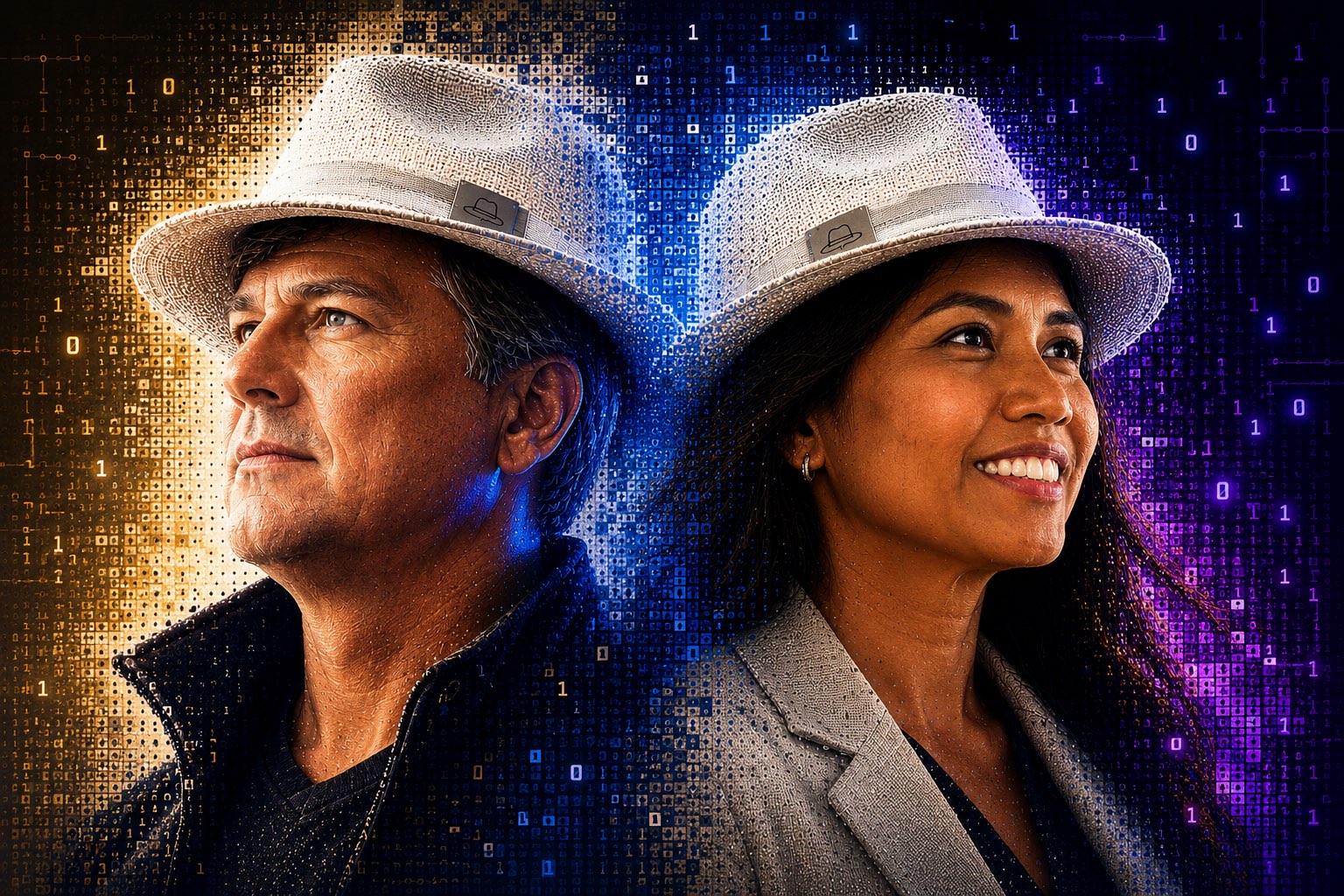
A British deep-tech architect and founder. A Filipino media leader. He builds the trust. She builds the reach. Together they forged The Possible.
Yes — husband and wife. The oldest cliché in the founder handbook, and we know it. But hear us out, because the cliché is the whole point.
They met in London: a deep-tech architect who had spent twenty-five years asking how complex systems stay trustworthy, and a marketing leader who had spent twenty taking ideas to the world and making them land. Two disciplines that almost never share a table — and happen to be the exact two halves a trustworthy autonomous age needs. The build, and the reach. So they stopped waiting for that table to exist, and built it.
Justin James
The build — trust by design
Co-founder
British, twenty-five years across silicon, banking, defence and marketing technology — equal parts engineer, architect and storyteller. From the Royal Navy's Antarctic survey ship to Intel's Itanium and the Windows kernel; enterprise architecture for Credit Suisse, Lloyd's of London and BAE Systems; an AI initiative at Linklaters on IBM Watson; a national-scale payments platform built for €30M and sold for €168M; a $100M cloud modernisation at Cognizant.
In 2022 he founded Agencie.io Labs and shipped thirteen production AI platforms on zero outside investment. Dyslexic and hearing-impaired, he reframes both as unfair advantages — purposeful listening, and systems thinking that sees the shape of a thing before the words. One question has followed him for twenty-five years: how do complex systems stay trustworthy as they grow autonomous? The Possible is his answer, in the open.
Veronica James
The reach — ideas that land
Co-founder · in an advisory capacity
A media and communications leader who built her craft across three continents — from Manila to London to Singapore. She began as a General Manager in the Philippines, leading a diverse portfolio of local and regional businesses; alongside this, she contributed to academia as a Professor of Communication. She later moved to London, taking on senior leadership roles across network management and regional business operations in Europe.
If the question is how systems earn trust, hers is how trust travels: how an idea finds the right audience, builds a network, and scales without losing what made it true. In a world where anything can be generated, that is the rarest skill — and the reason trust is the new reach.
“I translate trust into outcomes.”
Why they forged The Possible
“For thirty years I watched good ideas die in the gap between the people who could see a thing and the people who could build, fund, govern and sell it. In the autonomous age that gap turns fatal — you cannot bolt trust on after the fact.”
Software is becoming intelligent and autonomous, and we are being asked to trust it before it has earned the right. That gap — between what is now possible and what we can responsibly believe — is the defining problem of the decade. You cannot solve it with a product. You solve it with the right people at the table from the very first sketch: founders, investors, operators and thinkers, with the lawyers, accountants and marketers who make it real.
So they built the table they wished had existed — part think-tank, part hackathon, part chemistry set, part deal room. Not to talk about the autonomous age, but to build it on purpose. Two people who are themselves that bridge — the build and the reach — bringing the right people to the fire.
See what we’ve built — the technical roadmap, and what’s left →